Yunnan Coffee History: The Surprising 130-Year Story Behind China’s Coffee
Every coffee origin has an origin story. The story of Yunnan coffee history begins with a single French missionary, a handful of arabica seedlings, and a remote village tucked into the mountains of western China. From that quiet start in the late 1800s, Yunnan coffee passed through state plantations, a multinational buying boom, a brutal price collapse, and a quality revolution that carried it onto the global specialty stage. It is a 130-year arc from one seed to a nearly 100-billion-yuan industry. By 2026 three Yunnan lots had crossed 90 points at the Cup of Excellence, and the EU had granted protected status to Baoshan Arabica Coffee.
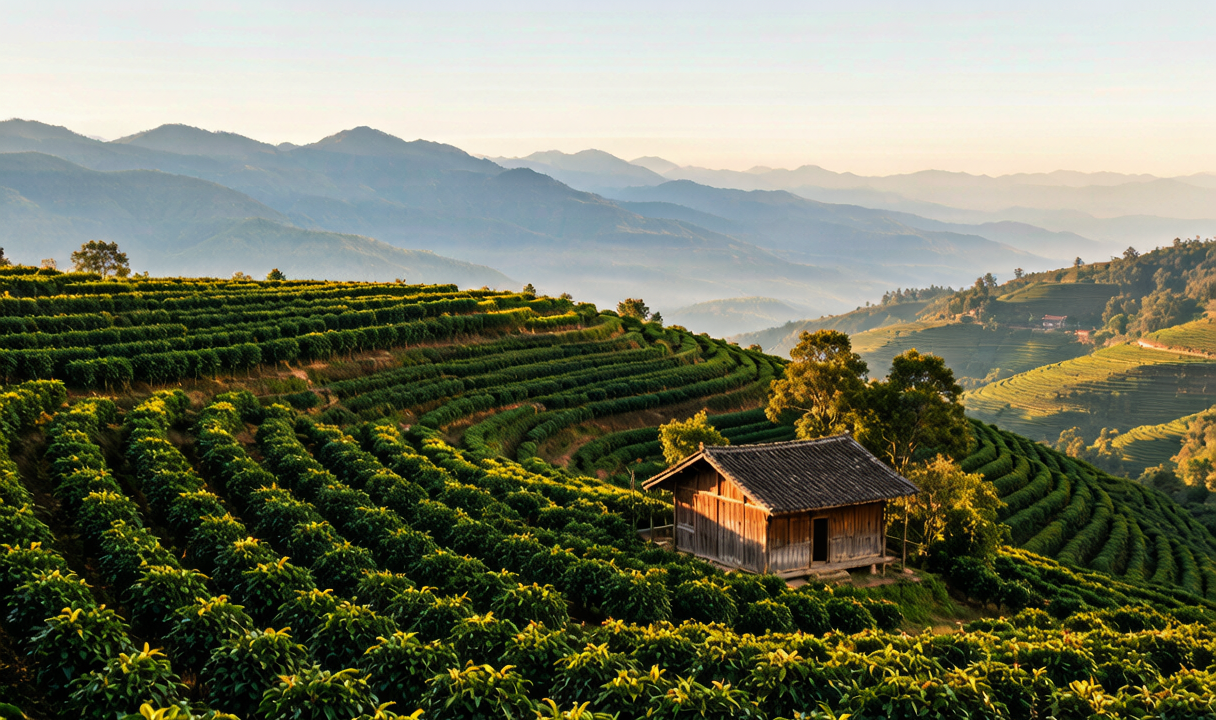
1. From a Single Tree to a National Industry
The arc of Yunnan coffee history spans more than a century and crosses five distinct phases. A single tree gave way to scattered village groves, those gave way to state farms, and the farms eventually fed a multinational procurement system. Then came a market crash that nearly hollowed the sector, followed by a specialty turn that changed how the outside world reads Yunnan.
By 2025 the scale was impossible to ignore. Planting area reached 1.463 million mu and annual output hit 138,900 tonnes, while the whole-industry-chain value approached 99.5 billion yuan.
Those figures sit at the end of a long road. The chapters below trace each turn, from seedling to auction lot.
2. The First Coffee Tree (Late 1800s)
The first coffee tree in Yunnan was planted in the late 1800s, around the turn of the 20th century, by a French missionary in Zhukula village, Binchuan County. Local accounts say the trees took hold in churchyard soil and mountain air, and the story is told as the origin of the whole region.
Two dates circulate for this event, and neither is settled. Some records point to the early 1890s, others to the first years after 1900. The honest telling stays vague: coffee reached Yunnan in the late 1800s, around the turn of the 20th century, carried by a missionary rather than a trade caravan.
The varieties mattered more than the exact year. The original Zhukula trees were Typica and Bourbon, the old arabica lineages that still define much of the region’s heritage stock. A few of those century-old trees survive in Zhukula today, treated less as a crop than as a living archive of how the whole story started.
3. The State Plantations (1950s–1960s)
After decades as a village curiosity, coffee became a state project. In the 1950s and 1960s, state farms took up cultivation in Baoshan’s Lujiangba valley, where the warm river basin proved well suited to arabica. The land reclamation bureaus organized the work at scale.
At the height of this period, Yunnan’s state farms produced roughly a quarter of China’s entire coffee output. The harvest did not serve a domestic cafe culture that did not yet exist. Instead the beans were sold through planned trade channels to the Soviet Union and Eastern Europe. The trade line is recorded in provincial histories such as People’s Daily Yunnan.
4. Nestlé Arrives (1988)
The modern commercial era opened in 1988, when Nestlé turned its attention to Pu’er and began building a local sourcing network. The company offered technical guidance, seedlings, and a reliable buyer, and growers responded by planting more.
The following two decades settled into a stable rhythm. Catimor, a hardy hybrid, drove the big expansion after 1991 and came to dominate the landscape so thoroughly that it still accounts for the large majority of historical plantings. The arrangement suited an era when volume mattered more than nuance. Nestlé wanted consistent supply for instant and blended products, and Yunnan supplied it.
That Catimor dominance built a reputation problem which lingered for years, a gap this origin is still closing in the Yunnan versus Colombian comparison. Outside buyers learned to read “Yunnan” as a synonym for cheap, functional beans.
5. The Market Opens (2000s–2010s)
The 2000s cracked the volume-only model. In 2008 the Hougu group pushed purchase prices past old ceilings and showed that local processing could capture more value at home. Starbucks began sourcing from Yunnan in 2009 and 2010, lending the origin a stamp of global credibility.
Scores told the next part of the story. A Yunnan lot crossed 81.5 points in 2012, the first clear signal that the region could reach specialty grade. A dedicated trading center opened in 2014, and in 2015 a rail freight service carried beans out by dedicated train. By 2016 a lot reached 87 points, a number that would have sounded impossible a decade earlier.
Each milestone chipped away at the old image. Yunnan stopped being only a bulk supplier and started being a place where a curious roaster might actually look for something good.
6. The Crash Years (2018–2021)
The expansion had a cost. Global arabica prices fell sharply, and Yunnan’s growers, many tied to commodity-grade Catimor, felt the squeeze directly. Farm-gate prices dropped below the cost of careful picking, and the math stopped working for smallholders.
A wave of tree-cutting followed. Growers pulled up coffee bushes and planted more profitable crops, and planted area shrank. Output fell to roughly half of its previous peak, a contraction documented in local industry reporting. The crash was painful, but it forced a question the sector had avoided: keep chasing volume, or rebuild around quality?
Weak growers exited, leaving space for better farming.
7. The Quality Turn (2022–2025)
Yunnan chose quality. A set of provincial support measures known as the “six coffee policies” backed processing upgrades, varietal renewal, and branding. The shift shows up in the numbers that matter most to drinkers.
The specialty rate climbed from 8 percent to 41.7 percent across these years, a leap that shows up in the Yunnan coffee flavor profile once the beans reach the cup. The deep-processing rate, the share of beans turned into finished or semi-finished goods rather than shipped as raw cherry, rose from 20 percent to 85 percent.
By 2025 comprehensive output value reached about 8.66 billion yuan.
The price story flipped too. From the 2023 season onward, Yunnan’s better lots began selling above international reference prices, a lasting inversion rather than a one-off spike. The origin that once competed only on cheapness started commanding a premium for cup quality.
8. Recognition on the World Stage (2024–2026)
Outside recognition arrived on schedule with the quality gains. In 2024 Baoshan Arabica Coffee, the Baoshan small-grain coffee, received protected geographical indication status from the European Union, a formal mark documented by China.org.cn and covered by Global Times.
The following year Yunnan coffee entered the Ministry of Foreign Affairs gift library, putting it alongside a small set of products chosen to represent Chinese craft abroad. Then, as of 2026, three Yunnan lots each scored above 90 points in the Cup of Excellence competition, and one took a presidential award. That competition is organized by the Alliance for Coffee Excellence.
Taken together, these milestones moved Yunnan from a footnoted supplier to a named origin on the specialty map. The arc that began with one missionary’s seedling now ends on an auction stage.
9. How to Read Yunnan Coffee’s Marketing Story
A fast-growing origin attracts fast-growing marketing. Travelers and buyers who visit Yunnan’s estates and scroll its social feeds pick up a set of claims worth reading with care. The history above is the best tool for telling signal from noise.
One claim to check is the “century-old tree.” Zhukula does hold genuine old-growth trees from the 1800s, but those are a tiny heritage stand, not the source of most beans on the market. A bag labeled “century-old” from a random estate rarely traces back to that grove. The heritage is real; the supply is not what the label implies.
Another is “estate direct supply.” Plenty of small roasters buy through traders and co-ops rather than standing in a Yunnan field. This claim sounds intimate and is often true in spirit, yet the actual chain usually runs through middle layers. Knowing the region’s geography, covered in the guide to Yunnan’s coffee growing regions, helps a buyer judge whether a claim fits the land.
A third is the “organic” or “specialty” tag used as a blanket mark. Certification and marketing language are not the same thing. A useful read comes from hands-on tasting knowledge: visitors to places like the Torchpoint roastery in Kunming describe a moment of disenchantment, when they learn to taste past the story and judge the cup itself (local visitor account). That skill, more than any label, protects a buyer from paying for a narrative.
A newer wrinkle is the “Geisha” label. The variety’s prestige has spawned a wave of Geisha-branded lots across Yunnan, yet altitude and processing, not the name alone, decide quality. Claims of “officially recognized” or “award-winning” deserve a second look: check which body granted the recognition, and whether a competition score backs the boast (consumer account).
Local grower accounts add texture the data cannot. One elderly farmer in the Pu’er hills still recalls the cutting years, when neighbors pulled up bushes almost overnight and the smell of cleared land hung over the valley for a season (local grower account).
Estate visits often surprise newcomers with how manual the work stays, rows picked by hand with no machinery in sight. A common consumer misunderstanding persists that Yunnan coffee is one uniform taste, when altitude, varietal, and processing split it into many distinct cups (consumer account).
For buyers, the takeaway is practical. A buyer who knows the history asks what a label actually means, and prices the bean by the cup, not the story.
10. Key Milestones at a Glance
The full arc splits into four stages, each with its own logic.
10.1 Origins (Late 1800s–1949)
In the 1890s a French missionary introduced coffee to Zhukula, planting Typica and Bourbon. In 1952 the Baoshan Lujiangba trial planting succeeded, proving the valley could carry arabica at scale.
10.2 Scale-Up (1950s–1988)
Through the 1950s and 1960s state farms reached roughly a quarter of national output and shipped to the Soviet Union and Eastern Europe. In 1988 Nestlé turned to Pu’er and seeded the commercial era.
10.3 Marketization (1988–2022)
Catimor drove a large expansion after 1991 and came to dominate historical plantings. Hougu broke price ceilings in 2008. Starbucks sourced in 2009 and 2010, and a trading center opened in 2014. The 2018–2021 cutting wave halved output and forced the quality question. The “six coffee policies” arrived in 2022.
10.4 Specialty and Global Reach (2022–2026)
From the 2023 season prices inverted above international references. The EU protected Baoshan Arabica Coffee in 2024. In 2025 the origin entered the foreign ministry gift library with a 41.7 percent specialty rate. As of 2026, three Cup of Excellence lots passed 90 points and one won a presidential award.
FAQ
1. When was the first coffee tree planted in Yunnan?
The commonly cited beginning falls in the late 1800s, around the turn of the 20th century, when a French missionary planted arabica seedlings in Zhukula village. Two dates circulate and neither is settled, so the safe answer stays vague rather than fixed to a single year.
2. How did coffee get to Yunnan?
Coffee arrived through a missionary, not through trade. The seedlings were carried into the mountains of western Yunnan and planted in churchyard soil, where Typica and Bourbon trees took hold and a few survive to this day.
3. Why is Yunnan the only major coffee-producing region in China?
Yunnan’s combination of altitude, tropical latitude, and frost-free valleys gives arabica the conditions almost no other Chinese province can match. The south and west of the province sit in a coffee belt that the rest of the country simply lacks.
4. What caused the Yunnan coffee crisis around 2019?
Falling global arabica prices met a sector built on commodity-grade Catimor. Farm-gate returns dropped below picking costs, growers cut trees and switched crops, and output fell to about half its previous peak during the 2018–2021 slump.
5. Why did Yunnan coffee prices rise after 2023?
The sector had rebuilt around quality. Higher specialty and deep-processing rates meant better cups and finished goods, and from the 2023 season the stronger lots began selling above international reference prices, a premium that has held, not a fleeting spike.
Conclusion
The full span of Yunnan coffee history shows how one seedling in a mountain village became a near-100-billion-yuan industry in just over a century. The twists of that story, the missionary, the state farms, the crash, and the specialty rise, are not background noise. They explain why a Yunnan cup tastes the way it does and why its price moved the way it did.
Readers who want the ground-level picture should start with Yunnan’s coffee regions, where altitude and microclimate shape every lot. Those curious about the cup itself can turn to the Yunnan coffee flavor profile, and the Yunnan versus Colombian comparison adds useful context. More origins and brewing guides live across the full origin archive, with the next cluster of stories already in the works.
Leave a Reply