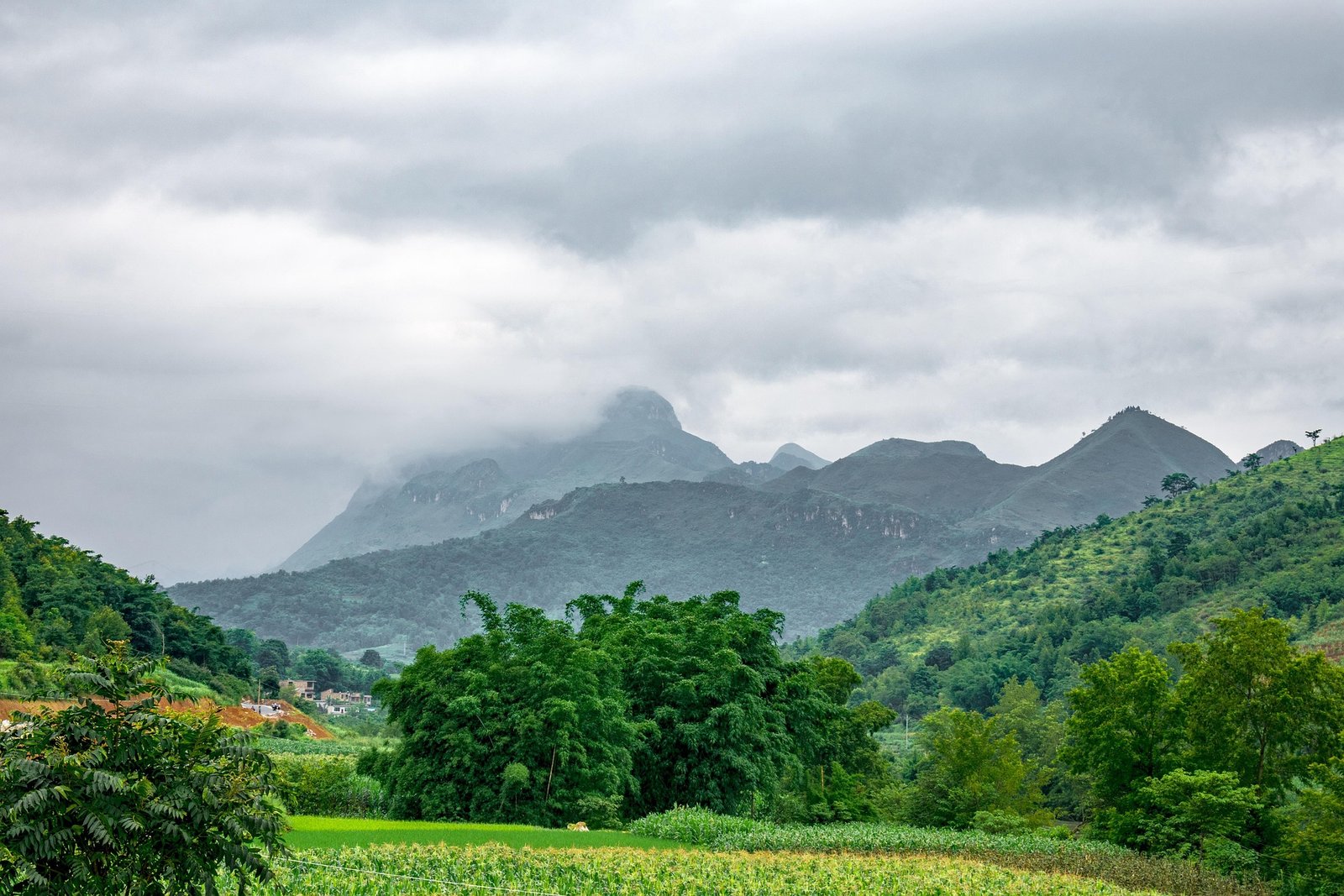
Yunnan coffee regions produce more than 98 percent of China’s coffee, yet most English-language guides treat the province as a single blurry origin. That picture is wrong. Yunnan is a collection of distinct growing zones, each with its own elevation, microclimate, and cup profile. This guide maps the four regions that define Chinese coffee, Pu’er, Baoshan, Lincang, and Dehong, and explains what sets each one apart. For a broader look at the province’s place in the global coffee belt, see the Yunnan coffee origin guide.
Why Yunnan Matters for Coffee
Yunnan sits on the eastern edge of the global coffee belt, between 21 and 25 degrees north latitude. The combination of low latitude, high elevation, and mountainous terrain creates the wide day to night temperature swings that coffee plants need to develop sugar and acidity. According to the Yunnan Department of Agriculture and Rural Affairs, the province cultivated coffee on roughly 1.46 million mu, about 97,500 hectares, and produced 138,900 tonnes of green beans in the 2025 season. Agricultural output value reached 8.66 billion yuan, up 77.8 percent year on year, while the full industry chain surpassed 99.5 billion yuan.
Those numbers explain why Yunnan is treated as China’s only serious coffee origin. The province accounts for more than 98 percent of national output. Export volume reached 32,500 tonnes in the 2025 cycle, a 358 percent jump that put Yunnan coffee into more than 29 countries, according to People’s Daily Online reporting from January 2026. The growth is not only in volume but in quality, as a rising share of the crop is now graded and sold as specialty.
Geographically, the four main regions fan out across the southwest. Pu’er and Lincang dominate the south central highlands. Baoshan sits to the west, and Dehong presses against the Myanmar border in the southwest. Reading them from north to south, or west to east, gives a rough map of how Chinese coffee is actually grown, and that map is the backbone of everything below.
Few origins this large sit entirely within one province. Most famous coffee regions spread across countries or continents, while Yunnan concentrates nearly all of China’s output in a single southwestern footprint. That concentration makes the province a useful case study: improvements in one region ripple across national supply, and a single weather event can move the whole crop. For buyers, it also means traceability is simpler, because the distance from farm to port stays short.
The shift from volume to value
For years Yunnan was known almost entirely as a commodity supplier, shipping bulk green beans into global blends. The 2025 figures show a different trajectory. Output value is climbing faster than raw tonnage, which means more of the crop is being processed, graded, and sold at higher tiers. That shift is what makes the regional differences matter: as buyers pay for cup quality, the distinct character of each zone becomes a selling point rather than a footnote.
Pu’er: The Coffee Capital of Yunnan
Pu’er is the center of gravity for Yunnan coffee. The region produces about 53.9 percent of the province’s crop across an estimated 700,000 to 790,000 mu of coffee land, grown at elevations from 1,000 to 2,000 meters. For readers comparing origins, the Yunnan coffee origin guide places Pu’er first for good reason: it is both the largest and the most developed coffee region in the country.
Varieties and cup profile
The dominant variety is Catimor, valued for yield and disease resistance. Higher end estates also grow Typica, Bourbon, and Geisha at the farm level, where altitude and careful processing produce cleaner, more expressive cups. The typical Pu’er profile is balanced and clean, with mild fruit acidity and a medium body. It is an easy origin to recommend to drinkers moving from mainstream blends toward single origins.
Coffee tourism and the specialty climb
Pu’er has built the province’s strongest coffee tourism scene. The city counts more than 300 cafes, and specialty grade volume has climbed from under 5 percent of output to over 30 percent in five years. On busy days, coffee tourism draws roughly a thousand visitors, turning former trading towns into destinations where people taste the origin at the source. That tourism feedback loop pushes farms toward better processing, because visitors can taste the difference directly.
Baoshan: Where Chinese Coffee History Began
Baoshan holds the deepest roots in Chinese coffee. The area’s small grain arabica was introduced in the 1950s, and the name now carries formal protection: a national geographical indication from 2010 and European Union GI protection added in 2024. Elevation runs from 535 to 3,781 meters, with the coffee belt centered between 1,100 and 1,500 meters on red laterite soils.
Old Typica and a protected name
Old Typica trees form the backbone of Baoshan’s reputation, supplemented by Geisha, Bourbon, the Yunka No. 1 cultivar, and the Derex series. Local descriptions sum up the cup as strong but not bitter, aromatic but not harsh, with a hint of fruit. That phrasing captures a coffee that is rounded rather than aggressive, leaning on body and sweetness more than bright acidity.
Records and momentum
Baoshan also sets national production records. Yields have reached 363.5 kg per mu, the highest recorded in China. In the first half of 2025, the region’s output value hit 6.079 billion yuan, up 107 percent. As the original home of Chinese arabica, Baoshan remains the reference point for the country’s coffee heritage, and the EU protection gives its name weight in export markets.
Lincang: The Rising Second-Largest Producer
Lincang is the province’s second largest coffee region. In 2024 it cultivated about 233,700 mu and produced 23,000 tonnes of green beans. Its elevation range is the widest of the four main regions, from 450 to 3,249 meters, which lets growers match varieties to altitude with unusual precision.
Altitude driven variety choices
Above 1,100 meters, farms plant Geisha, Catuai, and Villa Sarchi. Below that line, the Derex series dominates. The high altitude cups show citrus, sugar, and nut tones with a floral lift, a signature that has attracted commercial roasters looking for consistent volume with character. Washed processing is the norm, supported by the region’s dry harvest window.
A planned growth engine
Lincang is a core base for large chained coffee supply and operates under a ten year development plan running from 2025 to 2035. The region’s trajectory matters because it shows where Yunnan’s volume is heading next. As Pu’er approaches maturity, Lincang is the growth engine, and its planned expansion will shape national supply through the end of the decade.
Dehong: The Seed Bank of Yunnan Coffee
Dehong plays a different role from the other regions. It cultivated about 81,700 mu in 2024 and spans elevations from 210 to 3,404 meters. Its real strategic value is genetics rather than raw tonnage.
The genetic backbone
Dehong supplies more than 80 percent of the coffee seed used across China and maintains a germplasm collection of over 1,100 accessions, the largest in the country. Varieties in rotation include Geisha and Derex 132. Beyond seed, Dehong hosts Asia’s largest instant coffee production line, making it central to the commercial and soluble side of the industry even when its green bean volume is smaller than Pu’er’s or Lincang’s.
Why it matters
For readers tracking the industry, Dehong is the quiet foundation. Without its nurseries, the expansion planned in Pu’er and Lincang would not be possible. Its work happens upstream of the cup, but it sets the genetic ceiling for everything grown elsewhere in the province.
Other Emerging Coffee Areas
Beyond the four main regions, Yunnan’s coffee footprint reaches into Xishuangbanna, Wenshan, Honghe, and Nujiang, plus a cluster of smaller flavor districts such as Menglian, Lancang, Jinghong, Ning’er, and Jiangcheng. Together these account for roughly ten distinctive micro origins. Most are small, but several already produce cups distinctive enough to appear in single origin listings.
As the specialty segment grows, these areas are where the next wave of named origins is likely to appear. A farm in Menglian or a cooperative in Lancang can now reach buyers directly, and their coffees are increasingly judged on their own terroir rather than lumped under a regional average. That fragmentation is healthy for the origin as a whole, because it rewards specific place and process over anonymous volume.
What Makes Yunnan Coffee Taste Different
The through line across all regions is terroir. Low latitude, high elevation, and sloping mountain land produce day to night temperature swings above 10 degrees Celsius, which slow ripening and build sugar in the cherry. The red laterite soils add trace minerals that show up as a fuller aftertaste in the cup. Higher farms generally show more acidity and aromatic lift, while lower blocks lean into body and chocolate tones, so elevation acts as a built in flavor dial across the province.
Processing follows the climate
Washed processing dominates in Pu’er and Lincang because the dry harvest window supports it. Natural, honey, and anaerobic fermentation are spreading on specialty estates, adding fruit and body to the cleaner washed base. The harvest runs from October to March, peaking between November and February, with lower farms picking earlier and high farms later. That staggered calendar is why fresh Yunnan lots appear over several months rather than all at once.
Where Yunnan sits on the flavor map
On the global flavor map, Yunnan sits between Ethiopia’s bright acidity and Brazil’s heavy body. It reads closest to Colombia but carries a mineral base note from the laterite soils. That positioning is why the regions above, rather than a single homogenized Yunnan, deserve separate attention. A washed Pu’er and a high Lincang Geisha are not interchangeable, and pretending they are loses the detail that makes the origin interesting.
FAQ
Which Yunnan coffee region produces the most coffee?
Pu’er leads by a wide margin, accounting for about 53.9 percent of Yunnan’s crop. It is both the largest by volume and the most developed for specialty grading and coffee tourism.
What is the best Yunnan coffee region?
There is no single best. Pu’er offers balanced, accessible cups; Baoshan delivers historical small grain Typica with a rounded profile; high altitude Lincang shows floral and citrus notes; Dehong is the genetic backbone rather than a cup competitor. The right region depends on the flavor you want.
What coffee varieties are grown in Yunnan?
Catimor is the workhorse across the province. Estates also grow Typica, Bourbon, Geisha, Catuai, Villa Sarchi, the Yunka series, and the Derex series, with variety choice tied closely to elevation and microclimate.
At what elevation does Yunnan coffee grow?
Most coffee grows between 1,000 and 2,000 meters, though the full range across regions spans from about 210 meters in Dehong to over 3,700 meters at the high ends of Baoshan. The core commercial belt sits around 1,100 to 1,500 meters.
Can visitors tour Yunnan coffee farms?
Yes. Pu’er in particular has built a coffee tourism scene with more than 300 cafes and daily visitors during peak season. Farm visits, tastings, and harvest experiences are increasingly available across the main regions.
Conclusion
Yunnan’s coffee is not one thing. It is four regions with different histories, altitudes, and cups, plus a ring of smaller origins still finding their voice. Pu’er is the capital, Baoshan the heritage, Lincang the growth engine, and Dehong the seed bank. Readers ready to taste the difference can start with washed lots from Pu’er or Baoshan, then follow the where to buy Yunnan coffee guide for sourcing options. To brew those beans at home, our cold brew coffee recipe walks through a simple long cold steep with Yunnan beans. The map above is only the starting point, and each region rewards a closer look.
Leave a Reply