Yunnan coffee taste is the question more drinkers are asking as the origin moves from bulk commodity to recognized specialty. For years Yunnan was known in international circles as a workhorse bean for blends rather than a single origin worth lingering over. That reputation is outdated.
Across the province’s four main growing regions, the flavor of Yunnan coffee is being redefined by higher elevations, better varieties, and more careful processing.
The result is a cup profile that is strong but not bitter, aromatic but not harsh, with a soft fruit note that sits somewhere between the bright acidity of Ethiopia and the heavier body of Brazil. For readers new to the province, the Yunnan coffee regions guide maps where each cup comes from.
What Does Yunnan Coffee Taste Like?
The short answer is a cup that is strong but not bitter, aromatic but not harsh, and touched with a light fruit acidity. That phrasing is not marketing. It is the standard description repeated by the Yunnan provincial government and by state media such as People’s Daily when describing the province’s arabica. International cupping events tell the same story from the other direction. At a Barcelona cupping reported by People’s Daily in late 2025, Yunnan samples drew notes of tea, floral character, fruit, and earth in varying measures.
The through line is balance. Yunnan coffees tend to avoid the extremes: not the razor sharp acidity of a washed Ethiopian, not the syrupy heaviness of a Sumatra. Instead the cup aims for what one Chinese coffee publication called an eastern sense of balance, a coffee that is easy to drink and hard to fault. The sections below explain why, by breaking the cup down into the factors that actually build flavor.
Terroir: Where the Flavor Comes From
A useful rule of thumb from Yunnan cupping analyses is that roughly 70 percent of a coffee’s character is set by terroir, the combination of variety, elevation, and climate, while processing and roasting account for the remaining share. That split is the starting point for understanding the Yunnan coffee taste. Yunnan’s terroir is unusual because the province packs so many growing conditions into a small area. Three elements do most of the work. Together they explain why two farms a few kilometers apart can taste completely different, and why a single region can span everything from an everyday drinking blend to a competition lot. The sections below take each element in turn.
Elevation and the temperature swing
Most Yunnan coffee grows between 1,000 and 2,000 meters, with the core belts of Pu’er and Baoshan centered around 1,100 to 2,000 meters. Height alone matters less than the day to night temperature swing, which commonly exceeds 10 degrees Celsius in the highlands. That swing slows the ripening of the cherry, giving sugars and aromatic compounds more time to build. Higher farms generally show more acidity and aromatic lift, while lower blocks lean into body and chocolate tones, so elevation acts as a built in flavor dial across the province.
Laterite soil and the mineral finish
The red laterite soils common across Yunnan’s coffee hills carry trace minerals that show up as a fuller aftertaste and a subtle mineral base note in the cup. This is the detail that most often surprises tasters who expect a generic Asian coffee. The mineral thread is part of why Yunnan reads as its own origin rather than a copy of somewhere else, and it is most noticeable in cleaner washed lots where nothing else covers it up.
Monsoon climate and the dry wet rhythm
Yunnan sits inside the subtropical and southern subtropical monsoon zone, with a distinct dry and wet season and plentiful rainfall. The coffee belt here runs between roughly 21 and 25 degrees north, with average temperatures around 18 to 25 degrees Celsius, annual rainfall near 1,500 to 2,000 millimeters, and soil pH in the 5.0 to 6.5 range. The dry harvest window, typically October through March, is what makes washed processing viable at scale, because ripe cherries can be pulped and dried without rain interrupting the beds.
How Variety Shapes the Cup
Variety is the second big lever. Yunnan grows a wide range, from legacy commercial stock to carefully nursed specialty cultivars, and each carries a recognizable flavor signature. The spread is wide enough that variety choice alone can move a coffee from a quiet daily drinker to a competition contender, which is why estates now invest as much in genetics as in processing.
Catimor: the workhorse baseline
Catimor is the variety that built Yunnan’s volume. Historically it accounted for the large majority of the province’s plantings thanks to its yield and disease resistance. In the cup it shows a nut and cocoa base, low acidity, and a rounder, quieter profile. That is exactly why it suited a commodity origin, and why the most interesting Yunnan cups now tend to come from other varieties grown alongside it.
Typica, Bourbon, Geisha and the Yunka series
The specialty tier is where Yunnan gets expressive. Old Typica brings sweetness, mildness, and a smooth mouthfeel. Bourbon adds a berry like acidity with a creamy texture. Geisha, the variety that now headlines competition lots, shows citrus, floral, and honeyed notes. Yunnan’s own breeding work produced the Yunka series, with Yunka No. 1 showing floral, citrus, caramel, and a smooth finish, and Yunka No. 2 leaning into berry, caramel, and a juicy texture. Caturra and Villa Sarchi fill in with clear, bright acidity and caramel sweetness. The variety table below summarizes the cup each one tends to deliver.
| Variety | Typical flavor notes |
|---|---|
| Typica | Sweet, mild, smooth |
| Bourbon | Berry like acidity, creamy mouthfeel |
| Geisha | Citrus, floral, honeyed |
| Yunka No. 1 | Floral, citrus, caramel, smooth |
| Yunka No. 2 | Berry, caramel, juicy |
| Caturra | Bright, clear acidity |
| Villa Sarchi | Caramel sweetness, pronounced acidity |
| Catimor | Nut and cocoa base, low acidity, rounder cup |
The Elevation Flavor Ladder
Elevation is so consistent in Yunnan that it behaves like a flavor ladder. Walk up the hillside and the cup changes in a predictable order, from earthy at the bottom to floral at the top. This is where the Yunnan coffee taste shows its clearest range. The pattern below is a practical guide for guessing a coffee’s character from its growing height alone.
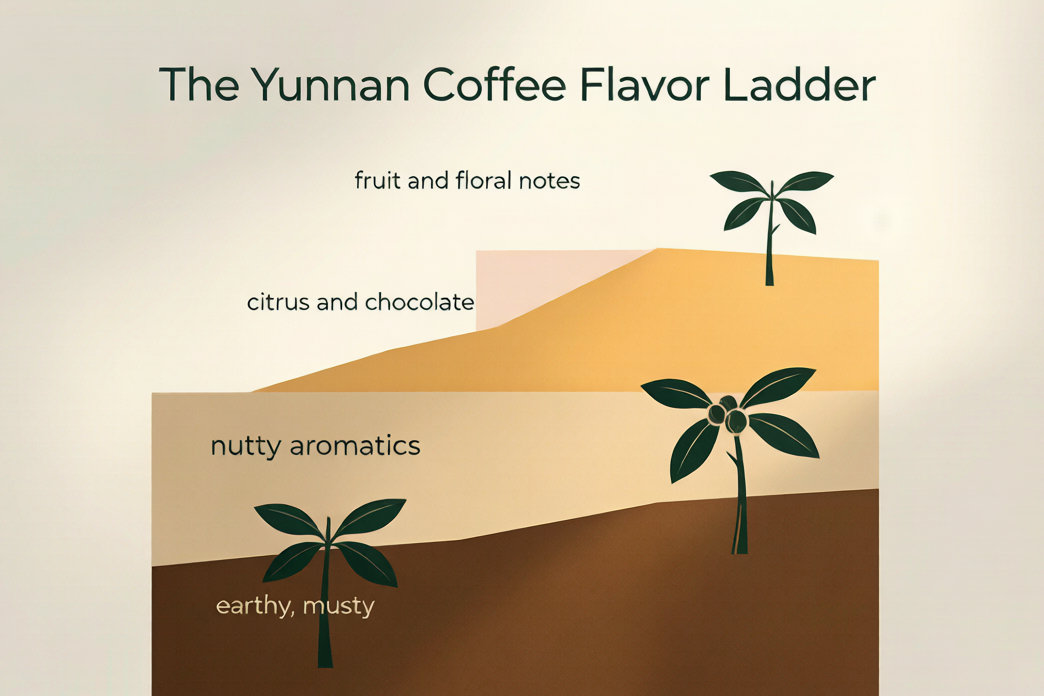
| Elevation | Flavor notes |
|---|---|
| Below 600 to 700 m | Earthy, musty notes |
| Around 900 m | Nutty aromatics |
| Around 1,200 m | Citrus and chocolate |
| Around 1,500 m | Clear fruit and floral notes |
This ladder is why altitude appears in almost every Yunnan tasting note. A 900 meter lot and a 1,500 meter lot from the same region can taste like different coffees, and the difference is mostly height plus the processing that height makes possible.
Processing: Washed, Natural, Honey, Anaerobic
Processing is the third lever, and the one producers control most directly. Yunnan practices the full spread of modern methods, and each moves the cup in a clear direction.
Washed dominates in Pu’er and Lincang, where the dry harvest window supports it. The result is clean, bright, and low in defects, which is why washed lots are the default for showing off terroir. Natural processing, more common in Dehong and Xishuangbanna, lets the cherry ferment fully with the seed, producing tropical fruit and a boozy depth. Honey processing sits between the two, often yielding jasmine, floral, and vanilla sweet notes. Anaerobic fermentation, still a frontier technique on specialty estates, pushes toward wine like body with berry and tropical fruit intensity. As a rule, the cleaner the process, the more the variety and elevation show through. Producers often choose a method to match the altitude and the weather of a given season, so the same farm may switch between washed and honey from one harvest to the next, and that flexibility is part of why Yunnan’s cup range keeps widening.
Regional Flavor Signatures at a Glance
Each of the four main regions has a recognizable signature, shaped by the factors above. The quick reference below is a starting point; the full regional guide goes deeper on each.
| Region | Flavor signature |
|---|---|
| Pu’er | Balanced, clean, light fruit acidity, medium body |
| Baoshan | Strong but not bitter, aromatic but not harsh, hint of fruit |
| Lincang | Citrus, sugar, and nut, with clear florals at high elevation |
| Dehong | Citrus, nut, and sugar tones |
Baoshan is worth calling out. Its cup is the source of the standard provincial description, strong but not bitter and aromatic but not harsh, and old Typica trees there are the backbone of that reputation. Lincang, the rising second largest producer, shows the clearest florals at altitude and is where the highest competition scores have lately come from.
Yunnan on the World Flavor Map
Placed against better known origins, Yunnan sits between Ethiopia’s bright acidity and Brazil’s heavy body. It reads closest to Colombia in overall balance, but carries that laterite mineral base note that Colombian coffee usually lacks. Against Indonesia it is lighter and cleaner than a typical Sumatra, which leans earthy and full. The honest summary is that Yunnan is not trying to be the most extreme origin. It is trying to be the most balanced, and for many drinkers that is the more useful cup.
The scores back the shift in perception. In 2012, Starbucks lead cupper Jeremy Wakeford scored a Pu’er coffee at 81.5 points. In 2016, former Specialty Coffee Association of America president Ted Lingle scored Yunnan at 87 points. By 2026, the second Cup of Excellence competition for Yunnan saw three coffees break 90 points, with the top score of 91.78 going to a washed Geisha from Gengxia Estate in Lincang. Those numbers track a move from anonymous bulk to recognized specialty, and they explain why the old reputation is fading.
FAQ
What does Yunnan coffee taste like?
Yunnan coffee tastes strong but not bitter, aromatic but not harsh, with a light fruit acidity. The cup aims for balance rather than extremes, sitting between the bright acidity of Ethiopia and the heavier body of Brazil, with a subtle mineral base note from the region’s red laterite soils.
Is Yunnan coffee bitter?
Not by reputation or by practice. The standard provincial description is strong but not bitter, and the high elevation, slow ripening growing conditions tend to produce rounded, sweet cups rather than harsh or astringent ones. Well processed lots are noticeably clean.
What is the best Yunnan coffee variety for flavor?
For flavor complexity, Geisha and the Yunka series lead, with citrus, floral, and honeyed notes. Typica and Bourbon are smooth and sweet, while Catimor is the reliable commercial base with a nut and cocoa profile. The best variety depends on the altitude and processing it is paired with.
How does Yunnan coffee compare to Colombian coffee?
The two are close in overall balance, which is why Yunnan is often described as Colombia like in structure. The main difference is a mineral base note from Yunnan’s laterite soils and a generally lighter, cleaner body. Both are approachable, balanced origins rather than extreme ones.
Why does the same Yunnan coffee taste different at different elevations?
Elevation changes the cup in a predictable way. Higher farms get a larger day to night temperature swing, which slows cherry ripening and builds sugar and aroma, giving more acidity and floral lift. Lower farms lean into body and chocolate tones. The effect is consistent enough that altitude alone is a reliable flavor clue.
Conclusion
Yunnan coffee has earned a new reputation. The old view of a bulk commodity is giving way to a balanced, expressive origin built on elevation, variety, and careful processing. The flavor is strong but not bitter, aromatic but not harsh, and quietly fruity, with a mineral thread that marks it as its own place. The Yunnan coffee taste you will remember is balanced, aromatic, and unmistakably Yunnan. Readers ready to taste the difference should start with washed lots from Pu’er or Baoshan, then explore the Yunnan coffee origin guide for the wider map. Those looking to buy can follow the where to buy Yunnan coffee guide for sourcing options. To taste that balance in a chilled cup at home, see our cold brew coffee recipe built around Yunnan beans. The cup is only getting better as more farms chase quality over volume.
Leave a Reply